
IHASA Newsletter
Autumn 2026
Member Spotlight
Ruth Trigg
With a brief history of IHASA
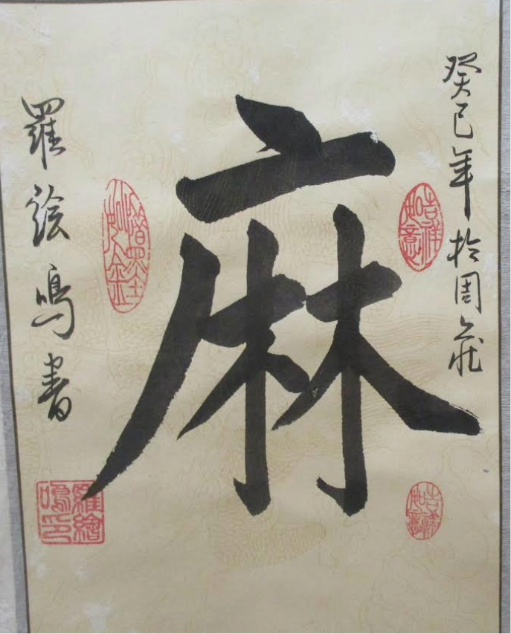
The Chinese symbol for hemp. It is a graphic of hemp stalks stacked upright in the field to dry, under an open ‘shed’ or cover.
Once this is recognised, the symbol can easily be recognised on clothing.
Although – it is still a thing that much of the fibre that comes out of China that is hemp is labelled as ‘linen’ for the European buyer.
My hemp journey
When I was ten, I stood on the bank at Wentworth looking at the spectacular sight of the muddy River Darling flowing into the crystal clear waters of the Murray. So clear, I could see fish swimming on the bottom. That sight has long since gone, the loss caused by human use along the banks.
Over the years and decades, driving through the river regions, I have seen agriculture and horticulture increase from a ribbon of green along the banks of the rivers to the extension of plantings to the horizon. The question formed – can the rivers and tributaries sustain this? And then, in the late ‘90s and early 2000s, driving behind semitrailers carrying irrigation piping, through desert-like landscapes, each trip seeing the diameter of the pipes getting larger and larger. And then, researching the cropping: from the days in the ‘50s of fruit and small areas of vines, to vast areas of almonds and other crops. And then seeing the white flecks along the roadside – what is that?? And the visual shock of the vast areas of baled cotton, and the extent of the dams to supply the water…
My father was a wool farmer on the Eyre Peninsula. We were passionately committed to the natural fibre of wool, and in summer, cotton. The knowledge of the growing of cotton in Dry Australia led to a conversion to hemp, and then a commitment to its significant qualities for growing and using, its history and its wide industrial applications, grew. I learned about the work of Henry Ford in making composites, for cars and other applications. And also the politicisation and repudiation of hemp with the advent of plastics derived from oil.
In 2012 and 2013 I was teaching in China. With the assistance of Austrade in Beijing, I made contact with the China Hemp Research Centre, then operating within the military. Three representatives from Austrade, my manager and I, were hosted for a half day at the Centre. We were shown the impressive work that this small research group had accomplished since the ‘70s to revive the growing of hemp in China, and to develop factories. The head of the unit, Professor Zhang (a four star general), had been a student in the US in the ‘60s, had exposure to the work of Ford, and returned to China with a proposal to make hemp socks and jocks for the soldiers – for longer wearing, sweat reducing, clothing. He gradually expanded the research and development unit in agriculture and factories with hemp for food and fibre.
When I returned from China in 2014, I joined IHASA, which Teresa McDowell had founded – and was developing a committee of committed supporters. Teresa had worked for many years creating the highest quality skin products. Graeme Parsons had recently joined to develop his interest in hempcrete for housing. My focus was increasing hemp production in Australia on the Murray Darling Basin and drastically reducing, even eliminating, cotton.
Teresa, Graeme and I worked hard for three years, with the support of the committee, to lobby the SA government to pass a law to allow farmers to grow industrial hemp in SA. We made contact with interstate groups, and eventually modified the Tasmanian legislation for SA. The Hon Tammy Franks was our most ardent supporter in Parliament in getting the legislation through in 2017.
I worked with Geert van Keulen and his class of TAFE students in graphic design to prepare a logo, and Gerben Vanderhoek provided pro bono graphic design support for posters and pamphlets.
In 2017 Graeme Parsons and I were invited as keynote speakers to an international Industrial Hemp Conference in Harbin, China, by the members of the China Hemp Research Centre, who organised the conference. We met many from Canada, Europe and China who shared valuable knowledge and experience. The conference organisers arranged a three-day trip for Graeme and me after the conference in the hemp-growing regions to meet growers and industry people, and visit factories. We were able to share these contacts and resources when we returned. We also hosted follow-up visits from several we met at the conference.
Back in SA we worked closely with the newly formed Industrial Hemp and Medicinal Cannabis Office, to instigate seed researchers for hemp at WAITE and Adelaide Uni, as well as organise trials with SARDI at Loxton, and connect with newly emerging growers.
It has been gratifying to see how the industry has developed slowly with high professional purpose with excellent people in research, farm practices, clothing, and high quality marketing. But the journey is very new, and so much more can, and must be achieved in order to address poor land and water use, and the propaganda connected to maintaining – and extending – damaging agricultural practices and industries.
I believe in multidisciplinary work. I would like to do more to make connections with university departments and students, to choose industrial hemp as research/project topics for extended work, always with an eye to keep educating the public, and influencing political decision-making about how and what resources of land and water are best developed.
I am very grateful for the professional and personal relationships I have made along the way on my hemp journey. I would like to acknowledge the devoted work of the first IHASA committee members, the focused lobbying work of Teresa and Graeme to get the law passed, and the stellar contribution of Bernard Thomson in guiding the committee in SA, and integrating IHASA with the interstate teams, functions and conferences.
Around the paddocks
Mick Andersen, Good Country Hemp
It’s an exciting time of year with hemp growing strong and fast in South Australia, approaching harvest next month.
Almost all plantings in SA this year are grain varieties for food production, with a small acreage of fibre varieties for future seed stock.
Hemp likes warm weather but unfortunately extreme days over 45 can be punishing, especially when the crop is at seedling stage about 2 weeks after emergence. Although the overhead irrigation system was working well and soil moisture was good, the small plants of one particular 50-hectare crop took a hammering and to the farmer’s trained eye it looks like it may impact the yield. However, 2 other crops which were sown 4 weeks earlier have powered through and are looking fantastic.
This season, four paddocks were sown between December 10 and February 3, which is a complete re-think of our previous practices. Normally sowing happens in a tight window in mid-November, which is often difficult for farmers to achieve, but the CFX-2 variety from Canada is auto-flowering, short season and therefore more flexible and forgiving, allowing farmers to fit hemp between other crops and their summer holiday plans. Other hemp grain varieties can take up to 115 days between sowing and harvest whereas CFX-2 takes 90 days or less. That’s quick, which also means less water use and less risk. That’s more boxes ticked!
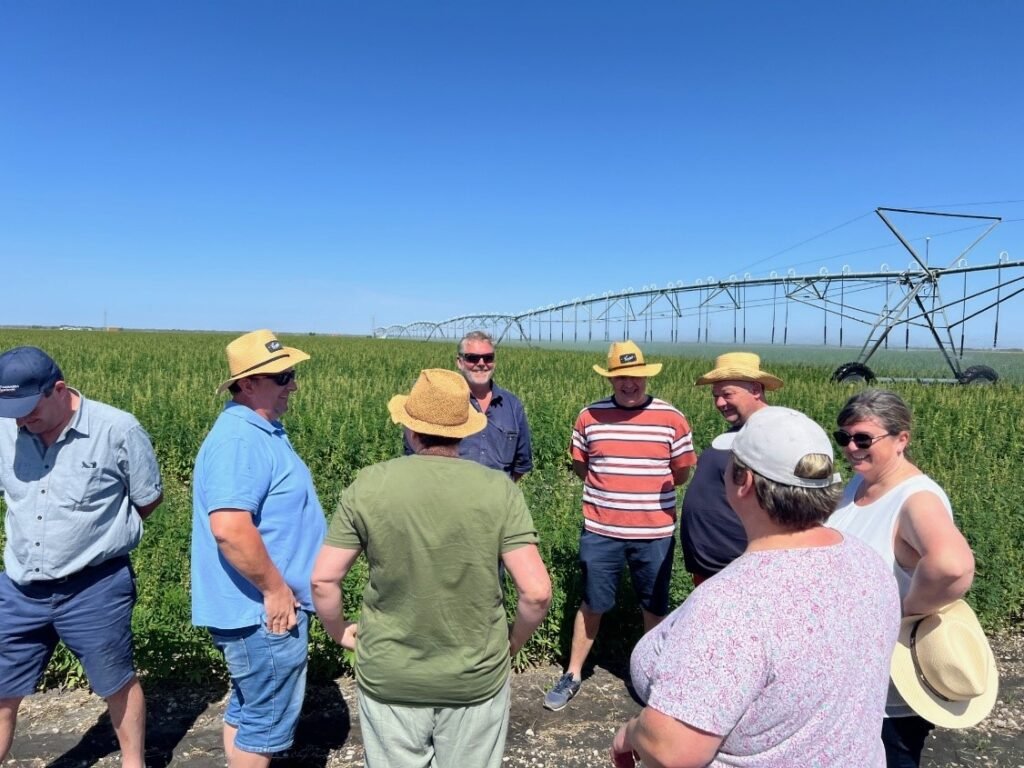
In January a group of 8 French farmers visited Steve and Mick Moulton’s farm near Coonawarra as part of a farm package tour of the Southeast region. Steve shared his wisdom about growing hemp and discussed his plans about processing hemp fibre locally for domestic and international markets. The guests tasted hulled hemp seeds, hemp seed oil plus hemp salad dressings, checked out hemp fibre harvesting machinery, and gave some great feedback about their experience. The tour organisers, Coonawarra Experiences, were impressed and keen to organise more tours including hemp in the future.
Good health,
Mick Andersen
HempToday
An interview with Bernard Thomson
HempToday provides important global hemp industry news and helps strengthen the community of growers, builders, manufacturers and other key players.
https://hemptoday.net/interest-in-the-other-essential-in-industry-where-we-must-learn-together-and-share-risk/
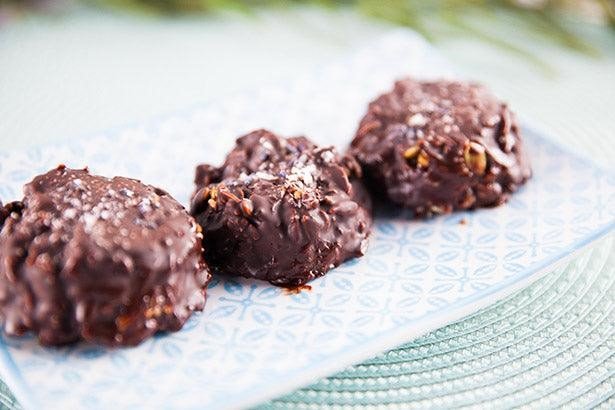
Hemp Recipe – Hemp Seed Cluster Snacks
Recipe by: Rosie Mansfield
Time: 30 minutes
Serves: 6
Ingredients
- ¼ cup honey
- 1 tsp vanilla extract
- 1 tbsp water
- 1 pinch salt
- ½ cup pumpkin seeds
- ½ cup sunflower seeds
- ¼ cup hemp seeds
- ½ cup almonds (optional)
- ½ cup cashews (optional)
- ¼ cup desiccated coconut
- ¼ cup coconut oil
- 1 block dark choc
- ¼ cup culinary lavender
Method:
- Preheat the oven to 150C.
- In a bowl mix honey, vanilla, water, salt, desiccated coconut and coconut oil in a bowl.
- Mix in seeds.
- Place in greased muffin tray holes and cook for 10-15 minutes.
- Allow to cool.
- Dip in melted dark chocolate with a fork and sprinkle with coconut, salt and lavender.
Season’s Greetings
Merry Christmas and Happy New Year
Wishing all our special members, families, friends, significant others, children and animal friends a wonderful festive season filled with love, health and happiness.
Also wishing everyone all the very best in every way for 2026.
Take care and be safe.


IHASA Committee Members
Mick Andersen
Good Country Hemp
Chris Martin
Committee Member
Dianne Sharpe
Newsletter
Tony Burfield
AHC Director for SA
Bernard Thomson
Membership & Treasurer
 Miller’s Corner is a sustainability – focused housing development in the Adelaide Hills. Our despair at seeing the types of development happening in the Adelaide Hills led us to seek alternative ways of building. After seeing a Grand Designs program on hemp building we decided to investigate using hemp in our project.
 After finding it was wasn’t legal to grow hemp in South Australia we joined the newly formed Industrial Hemp Association and began lobbying the government for a change of legislation. Unfortunately even with the new legislation it was not possible to purchase South Australian grown hemp. This led us to purchasing hemp from France which proved to be the most cost-effective method of getting hemp in South Australia.
 Building at Miller’s Corner is progressing with currently eight buildings at various stages of development including five which have used hemp as a building product. It is expected most buildings will be completed by the end of 2021. Our website